

Temazcal · Sweat lodge in Mexico The temazcal
A ritual steam bath and a wellbeing practice, whose origins go back to the pre-Hispanic medicine of the native peoples of the American continent.
The womb
The representation of the womb of Mother Earth
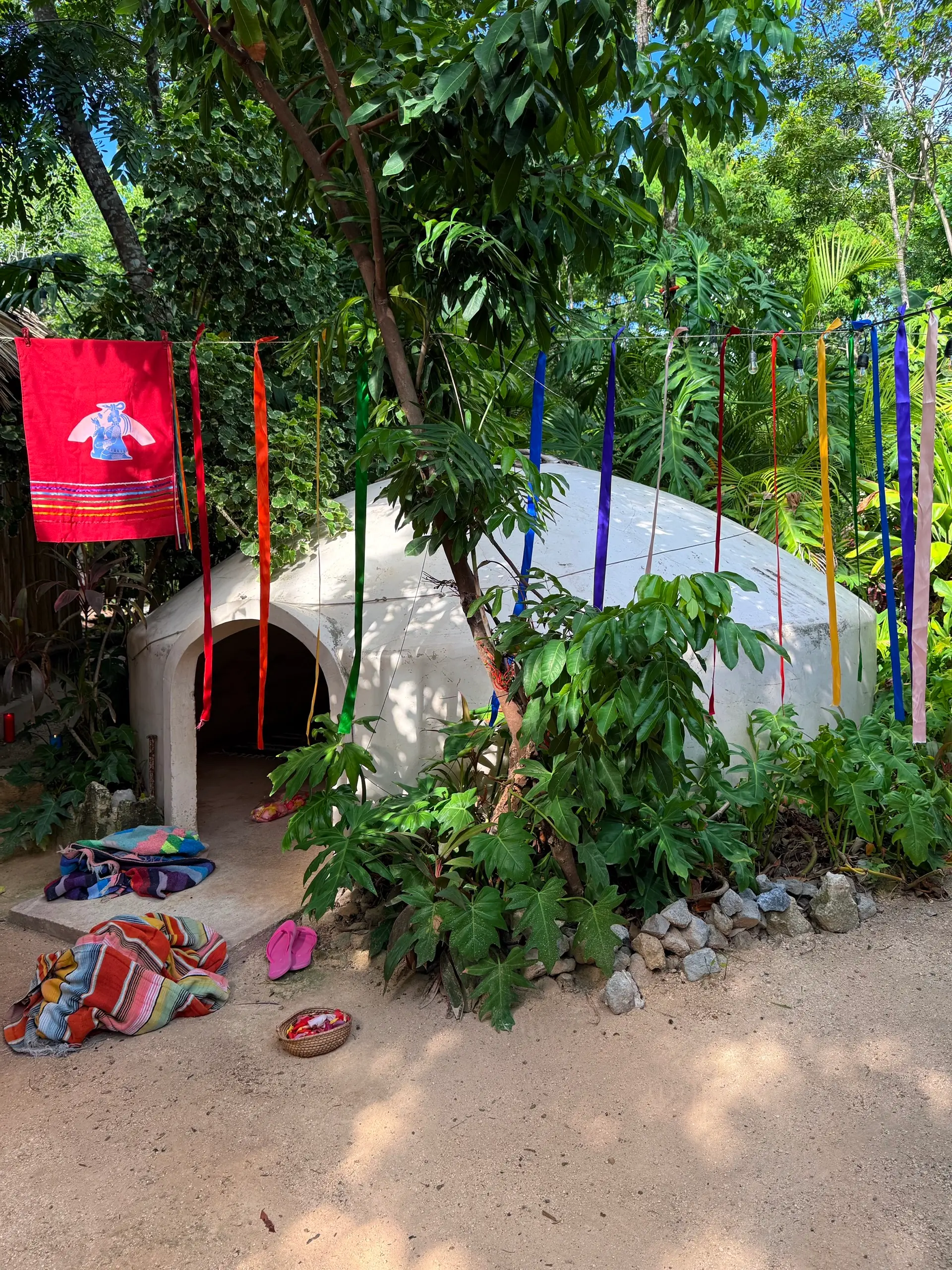
The temazcal is a low, dark, closed dome, shaped like an igloo. You crawl in, you sweat, and you come back out into the light. That is the figure: the womb, and coming out of it.
It is also a ceremony of rebirth through abundant sweating, the use of herbs, and the way those taking part meet the four elements that sustain life.
It is not esoteric and it is not a matter of faith. Heat and steam do something very concrete: they bring you back into your body, they make you breathe slowly, and they let you be grateful for what you can actually see.
The names
Temazcal, sweat lodge, sweat house
The word comes from Nahuatl: temāzcalli, from temāz, steam, and calli, house. The house of steam. It is an ancient practice of Mesoamerica, and people were going into one long before anyone wrote the word down.
In English it is usually called a Mexican sweat lodge, and that is the phrase most visitors arrive with. It is a fair translation. It is also worth knowing where it stops being one: the sweat lodge ceremony of the indigenous peoples of North America is a cousin of this, not a twin.
The clearest difference is the building itself. A temazcal is built to stay — a dome of masonry or adobe, shaped like an igloo, that belongs to its place and is used again and again. A sweat lodge is usually a frame of bent branches covered with blankets or hides, raised for the occasion and taken down afterwards.
What they share is the idea underneath: heat, steam and a closed dark space as a ceremony of purification. Ritual purification — the kind that is about coming out lighter than you went in. More questions like this one.
The four elements
Fire, earth, water and air
The four elements that sustain life. The ceremony is made with them, not with symbols of them. See how a private ceremony runs →
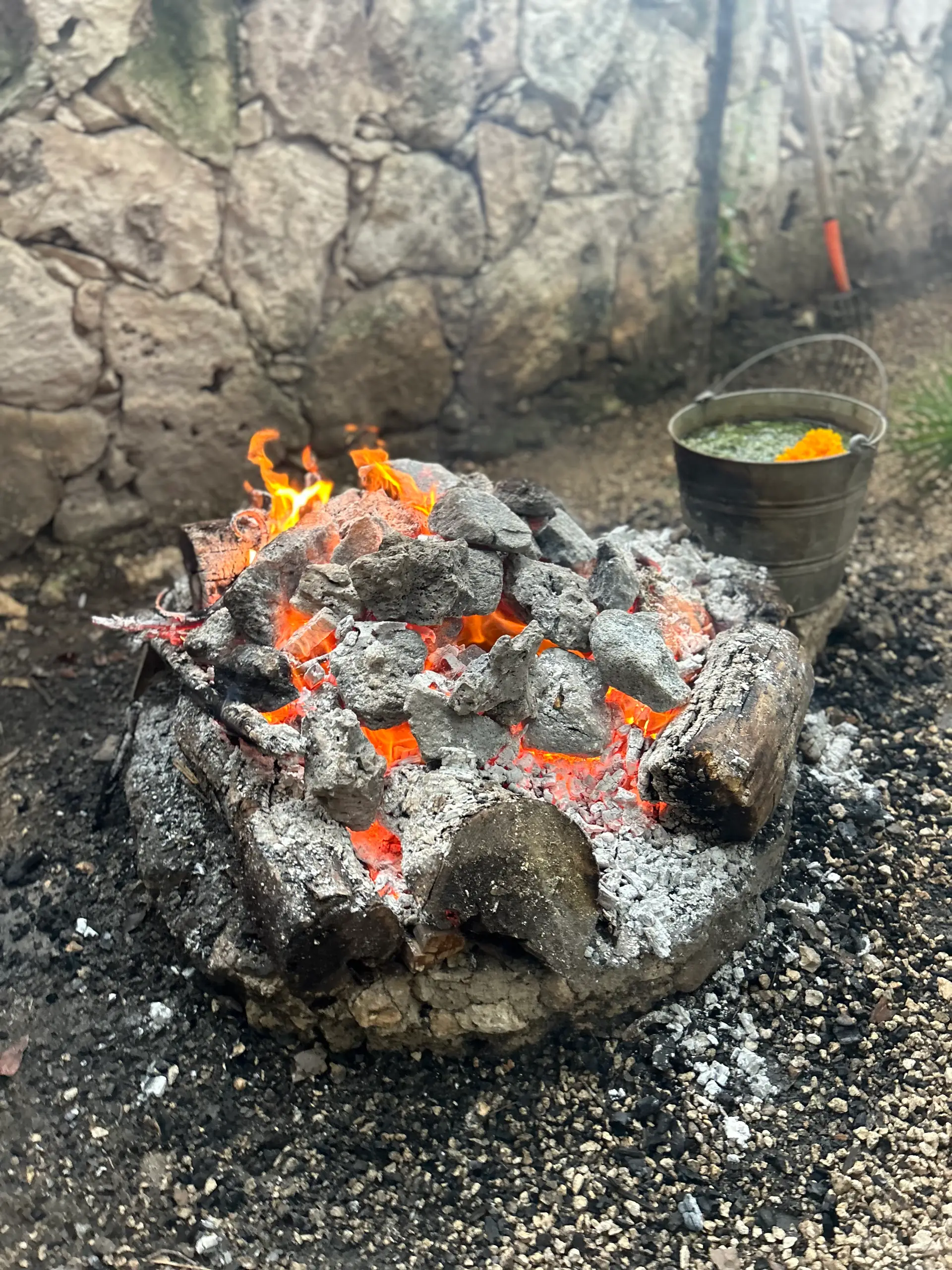
Fire
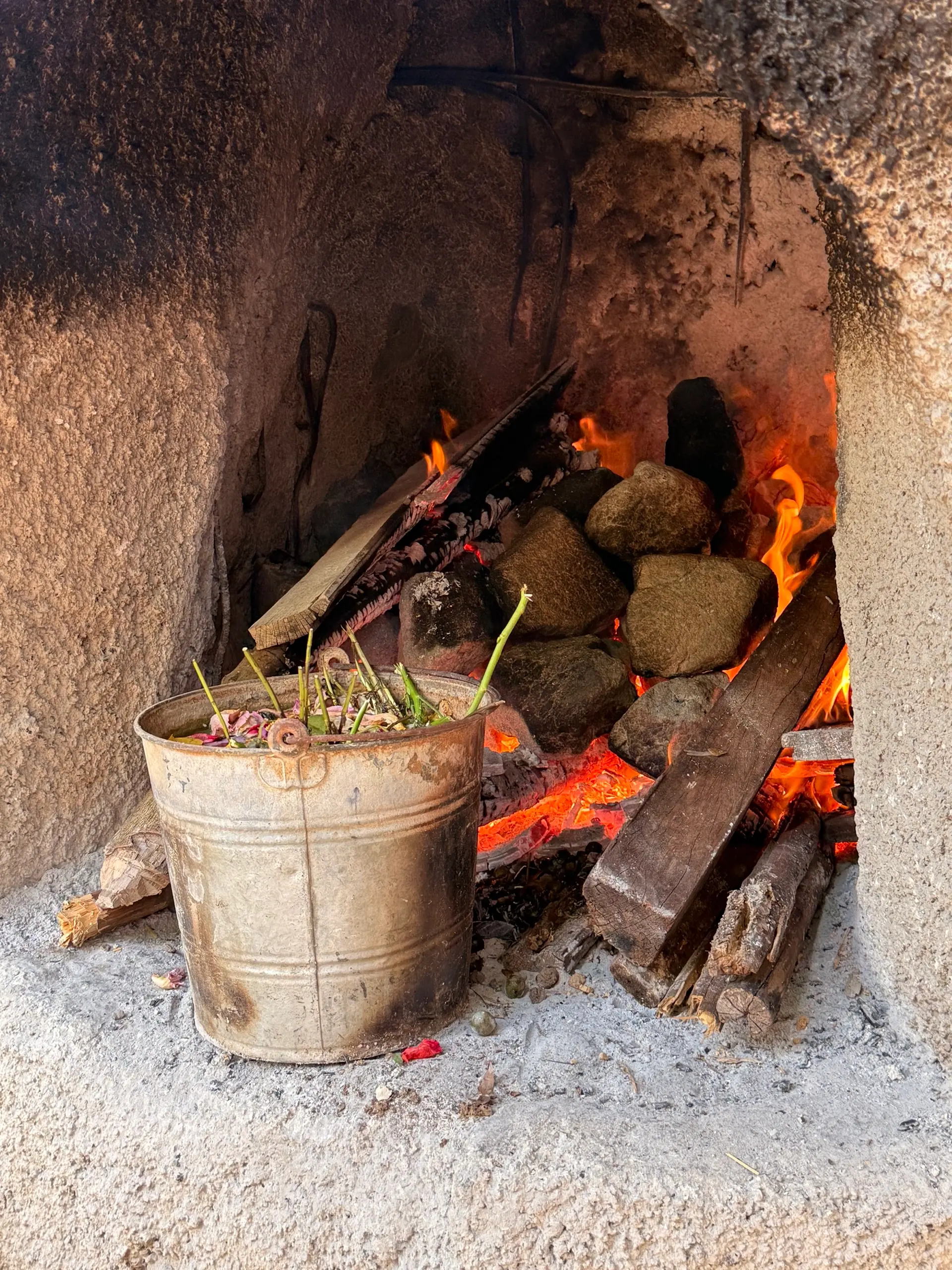
The fire heats the stones for hours before the ceremony begins.
Earth
The dome is the womb. You go in in the dark, you sweat, and you come back out into the light.
Water
Water steeped with herbs falls on the red-hot stones and turns into steam.
Air
Between one door and the next, fresh air comes in and the circle breathes again.
Before going in
The breathing meditation
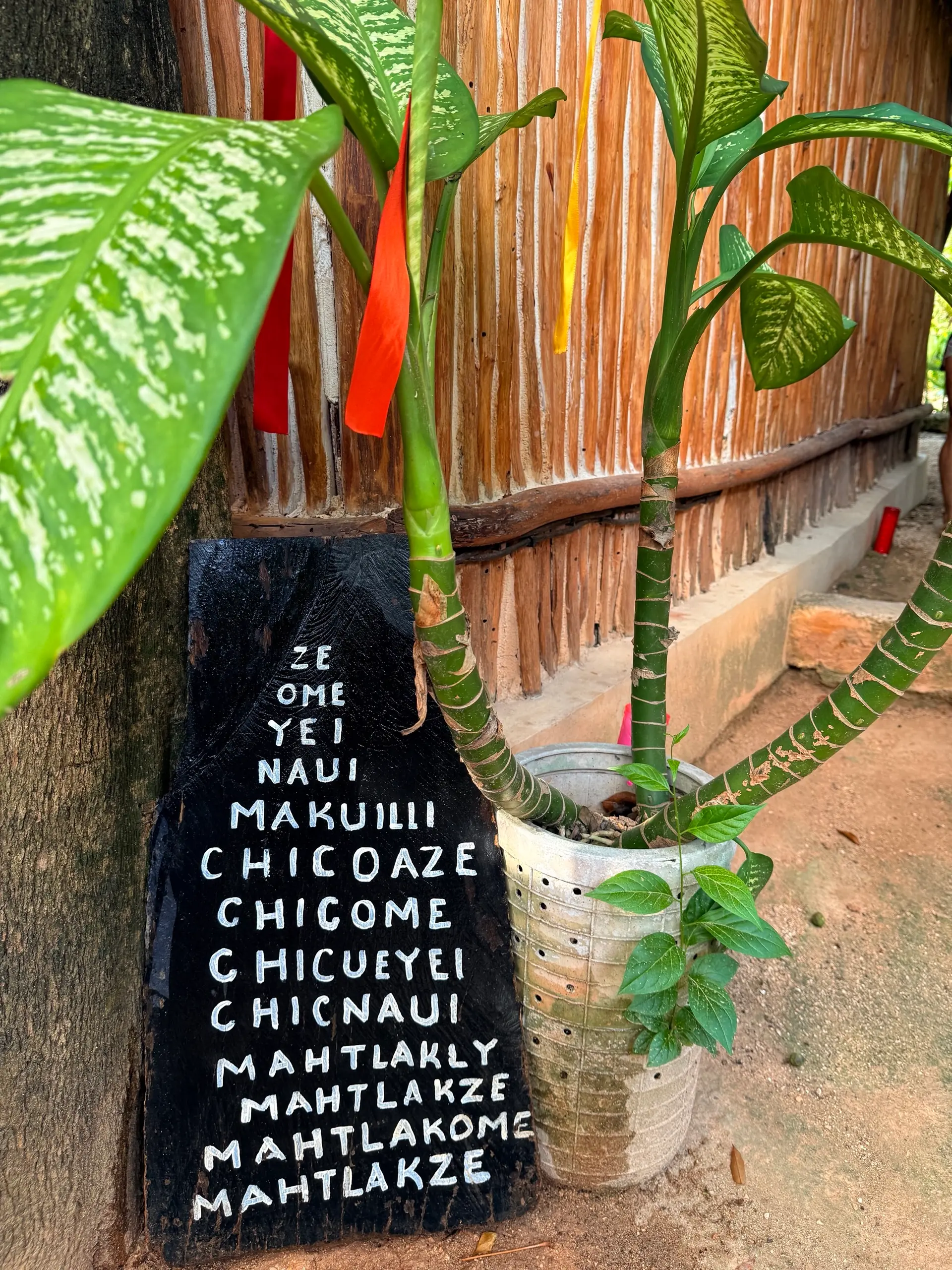
Outside, in a circle, we do a breathing meditation that travels through the seven chakras. Each one has its colour, and those colours are the ribbons you will see hanging along the path, on the altar and by the fire.
Inside
The four doors
The temazcal opens and closes four times. Each door faces a direction and carries its colour, and the circle travels through all of them: east, south, west and north.
-
1
EastSun and fireFirst dooryellow
-
2
SouthWaterSecond doorblue
-
3
WestEarth and fertilityThird doorred
-
4
NorthWindFourth doorwhite
Silence
A few seconds with a quiet mind
Inside it is dark, it is hot and there is nothing to look at. It is the part people talk about least and the one that does the most work: no screen, no conversation and no clock, and your head slows down on its own.
What comes up in that stretch is different for everyone. A memory. Something you had been putting off for weeks. An image. Or nothing in particular, which is fine too. A few seconds of silence with a quiet mind are good for the body and good for the person, and that needs no mystical explanation.
There is no wrong way to do it and you do not have to believe in anything. It is worth knowing how it works: the ceremony is four doors and it is lived through from beginning to end. Between one door and the next the entrance opens and fresh air comes in, but the circle is not broken and nobody leaves halfway. That is why the decision is made before going in, calmly and with the facts in front of you — that is what the questionnaire every participant fills in is for. Every decision carries a responsibility, and the first one is to yourself.
Herbs
The medicine is in the plants
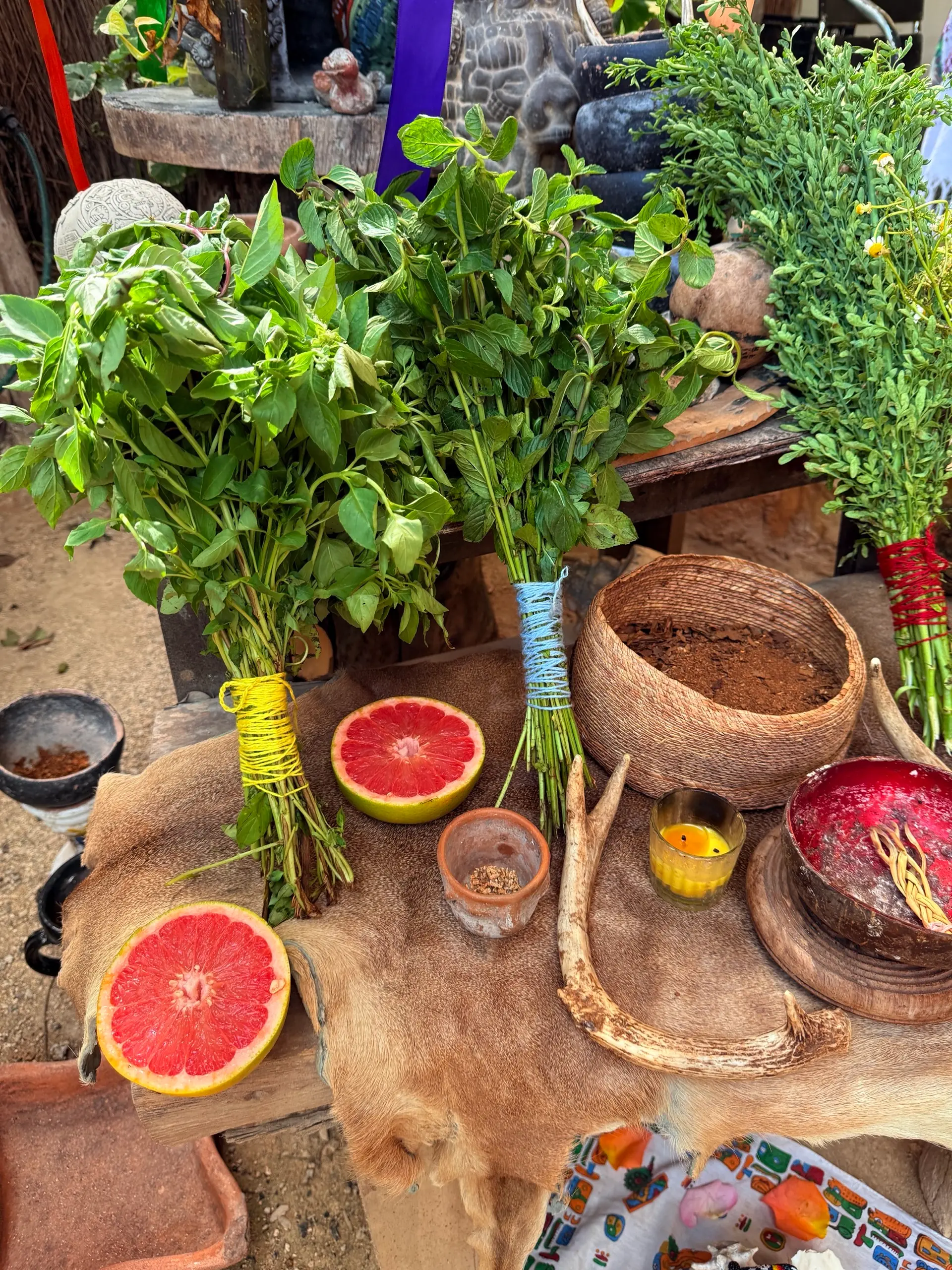
The temazcal contributes to physical, mental and spiritual health through the natural medicine held in plants. Every ceremony is prepared with the herbs the moment asks for.
-
LemongrassCymbopogon citratus
Its oil is rich in citral. Antibacterial, antifungal and anti-inflammatory properties have been studied in it.Used today one of the most common home infusions in Mexico, and also as a scent and a natural repellent.As a tea? yes — it is the everyday lemongrass tea, with fresh or dried leaves.Shah G. et al., J Adv Pharm Technol Res, 2011;2(1):3-8 -
PeppermintMentha × piperita
Menthol opens the breath and cools the skin in full heat.Used today the European Medicines Agency recognises the traditional use of the leaf for digestive complaints — indigestion and flatulence — and of the oil for the symptoms of coughs and colds.As a tea? yes. The leaf as an infusion is exactly the form the monograph covers.EMA/HMPC, European Union herbal monographs on Mentha × piperita L., folium and aetheroleum -
EucalyptusEucalyptus globulus
Its main compound is 1,8-cineole (eucalyptol), studied for its mucolytic and anti-inflammatory action on the airways.Used today mainly for the airways: inhalations, balms and cough syrups.As a tea? the leaf is taken as an infusion. The essential oil is not drunk: concentrated, it is toxic.Juergens U.R., Drug Res (Stuttg), 2014;64(12):638-646 -
ChamomileMatricaria chamomilla
One of the oldest and most studied medicinal plants. A mild calming and anti-inflammatory effect is documented for it.Used today for digestive discomfort and to help with sleep; also in rinses and compresses.As a tea? yes, and it is its most common form: the flower as an infusion.Srivastava J.K. et al., Mol Med Rep, 2010;3(6):895-901 -
BasilOcimum basilicum
In Mexican traditional medicine its best-documented use is stomach ache — in Morelos, Tlaxcala and Quintana Roo — along with other digestive complaints. Experimental studies have shown antibiotic activity and effectiveness against gastric ulcers.Used today outside the kitchen, for digestive complaints; its essential oil is studied as an antibacterial.As a tea? yes, as an infusion. But not during pregnancy: the same entry documents its use to bring on labour.Atlas of the Plants of Mexican Traditional Medicine, UNAM — entry for Ocimum basilicum -
RueRuta graveolens
In Mexican traditional medicine it is used above all for stomach ache, and a stimulant effect on the uterus has been demonstrated.Used today here it goes into the steam, for its scent.As a tea? no, and this one matters: the entry documents abortive, hepatotoxic and nephrotoxic action in animals, and in people it is irritant and photosensitising.Atlas of the Plants of Mexican Traditional Medicine, UNAM — entry for Ruta graveolens
Hover over — or tap — each plant to see what has been studied about it and where. We say what has been researched; we do not promise cures.
And many others, according to what the moment and the circle ask for.
Benefits
Wellbeing for body, mind and spirit
You do not have to believe in anything. People who live the ceremony describe that it helps them:
- Relax the body deeply
- Let go of emotional weight
- Breathe more freely
- Come out with the skin feeling different
- Feel the body awake
- Slow right down
- Let go of stress
- Sleep better that night
- Wake up their connection with nature
- Recognise the relationship between body, mind and spirit
A safe place for introspection and self-recognition, and a life experience worth living. It is not a medical treatment and it does not replace the care of a health professional: we do not cure anything.
The place
How it is prepared
Live the experience · Vive la experiencia
Live it
Every ceremony is private and arranged with you. Write to us and we will put yours together.
5.0 105 reviews on Google